TLA+ Modeling of AWS outage DNS race condition
2025-11-06
On Oct 19–20, 2025, AWS’s N. Virginia region suffered a major DynamoDB outage triggered by a DNS automation defect that broke endpoint resol...
I share interesting articles, videos, papers and more about distributed systems, formal methods and computer science.
On Oct 19–20, 2025, AWS’s N. Virginia region suffered a major DynamoDB outage triggered by a DNS automation defect that broke endpoint resol...
This post motivates TernFS, explains its high-level architecture, and then explores some key implementation details.
The goal with Aurora DSQL’s design is to break up the database into bite-sized chunks with clear interfaces and explicit contracts. Each component follows the Unix mantra—do one thing, and do it well—but working together they are able to offer all the features users expect from a database (transactions, durability, queries, isolation, consistency, recovery, concurrency, performance, logging, and so on).

In this article, I’m going to explain how connections to Aurora DSQL are authenticated and authorized. This information is meant to be supplemental to what is found in the official Amazon Aurora DSQL documentation.
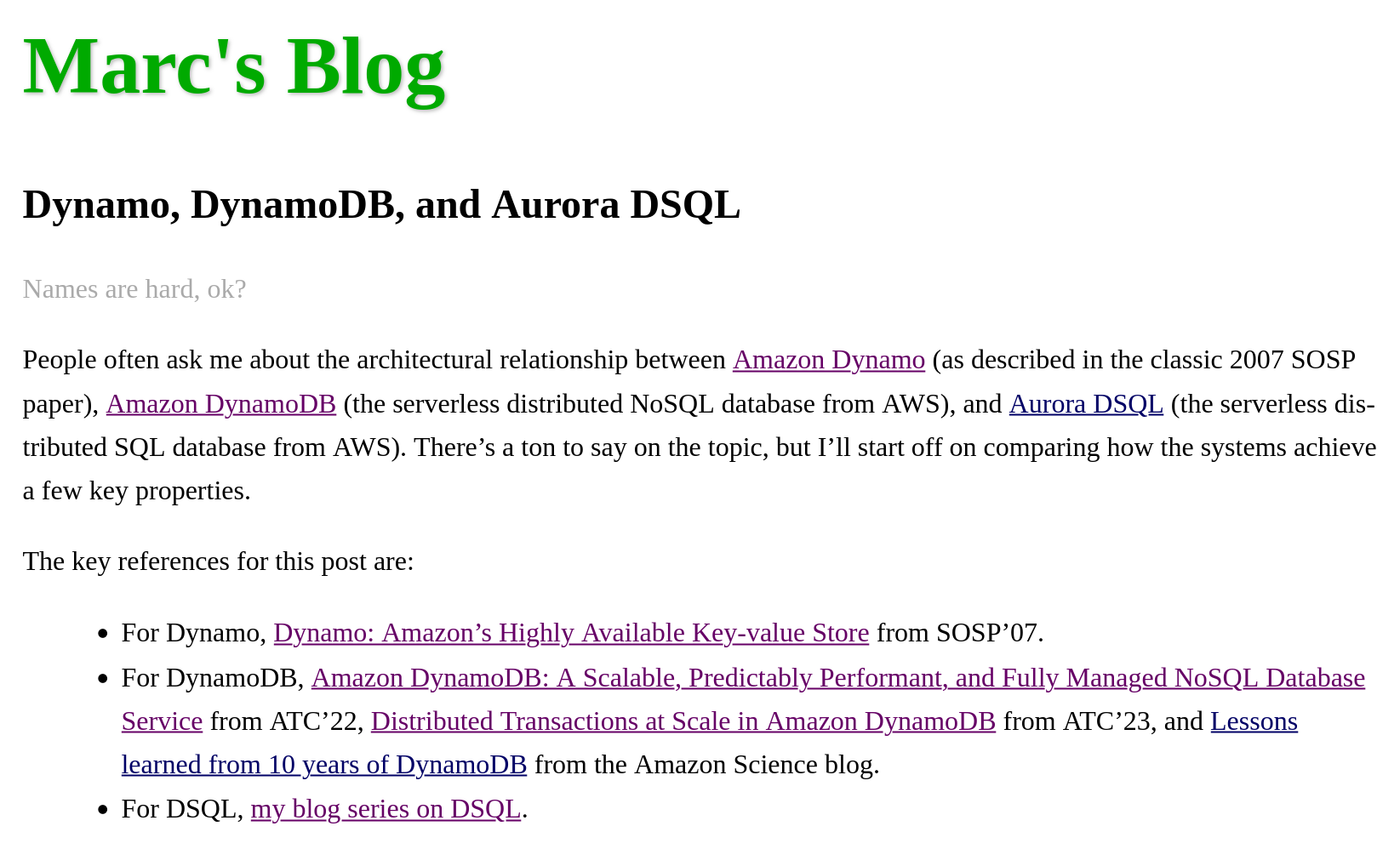
People often ask me about the architectural relationship between Amazon Dynamo (as described in the classic 2007 SOSP paper), Amazon DynamoDB (the serverless distributed NoSQL database from AWS), and Aurora DSQL (the serverless distributed SQL database from AWS). There’s a ton to say on the topic, but I’ll start off on comparing how the systems achieve a few key properties.
People often ask me about the architectural relationship between Amazon Dynamo (as described in the classic 2007 SOSP paper), Amazon DynamoDB (the serverless distributed NoSQL database from AWS), and Aurora DSQL (the serverless distributed SQL database from AWS). There’s a ton to say on the topic, but I’ll start off on comparing how the systems achieve a few key properties.
With S2, it is a hard requirement that our Stream API operations exhibit linearizability. Linearizable systems are far simpler to reason about, and many applications are only possible to build on top of data platforms that offer strong consistency guarantees like this. Because it's important, we also need to test it! We can gain confidence that S2 is linearizable by taking an empirical validation approach, using a model checker like Knossos, or Porcupine.
Learn how queues make horizontal scaling, scheduling, and flow control easier in cloud systems, and how to make them durable and observable.
We are on a path to build a strong foundation in distributed systems. We have already gone over distributed time; the next topic we will cover is Distributed Consensus. To build the foundation on distributed consensus, we will go over Paxos. Paxos revolutionized distributed computing by providing the first provably correct solution for achieving consensus among unreliable processors, forming the theoretical foundation for modern distributed systems and databases. Paxos is one of the most important and most difficult to understand algorithm. In this blog I will simplify and explain paxos in a very intuitive way.
Murat Demirbas (https://muratbuffalo.blogspot.com) and Aleksey Charapko (https://charap.co) read and discuss "Real Life Is Uncertain. Consensus Should Be Too...